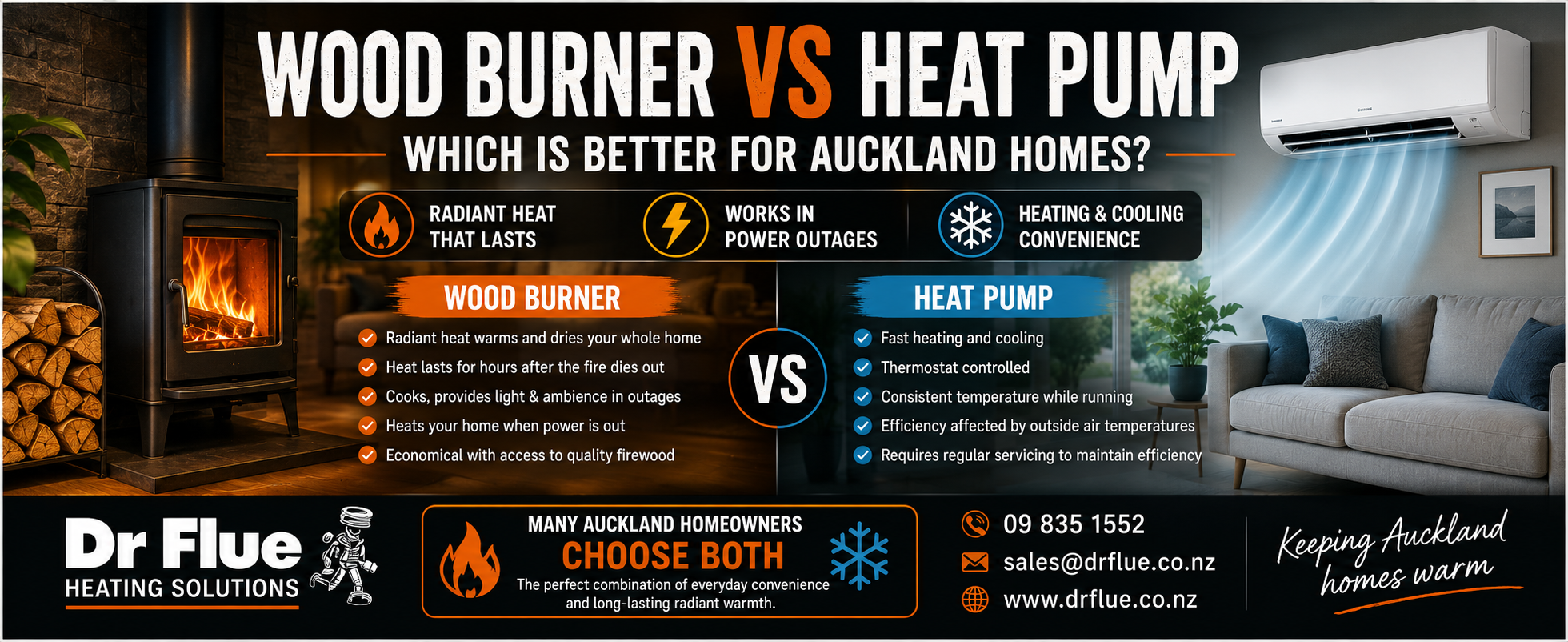
Wood Burner vs Heat Pump: Which Is Better for Auckland Homes?
When it comes to heating your home during winter, Auckland homeowners often ask:
"Should I install a wood burner or a heat pump?"
Both systems have their advantages, but they heat your home in very different ways.
For many homeowners, the decision is about more than simply producing heat. Comfort, running costs, reliability, power outages, home dryness and overall lifestyle all play a role.
Let's compare the two most popular heating solutions available for Auckland homes.
How They Heat Your Home
Wood Burners
Wood burners produce radiant heat.
Radiant heat warms:
Walls
Floors
Furniture
Soft furnishings
People within the room
Unlike heated air, radiant heat is absorbed into the structure of the home itself.
As walls, floors and furnishings absorb heat, they store that warmth and slowly release it over time.
Benefits include:
✅ Powerful heat output
✅ Long-lasting warmth
✅ Natural radiant heat
✅ Effective heating for larger living spaces
✅ Continued warmth after the fire burns out
Many homeowners describe wood burner heat as a deeper, more comfortable warmth than other heating systems.
Heat Pumps
Heat pumps primarily heat the air within a room.
Benefits include:
✅ Fast heating
✅ Thermostat control
✅ Consistent temperatures while operating
✅ Heating and cooling capability
✅ Convenient day-to-day operation
Heat pumps are excellent at maintaining room temperature while running, but they primarily heat air rather than the building structure itself.
Radiant Heat vs Heated Air
One of the biggest differences homeowners notice is how the heat feels and how long it lasts.
Wood Burner Heat
Wood burner heat is absorbed into the structure of the home.
As walls, floors and furnishings warm up, they store heat and slowly release it back into the room.
This creates:
More comfortable living spaces
Reduced dampness
Lower condensation
Drier indoor environments
Longer-lasting warmth
A major advantage of radiant heat is that it often spreads well beyond the room where the wood burner is installed.
As walls, ceilings and floors absorb heat, warmth naturally transfers throughout the home. In many Auckland properties, a correctly sized wood burner can help heat and dry much of the house rather than simply warming the immediate living area.
Many homeowners notice bedrooms, hallways and adjoining rooms becoming noticeably warmer even though the wood burner is located in the main living area.
The result is a home that feels warmer, drier and more comfortable throughout winter.
Many Auckland homeowners also find their home remains warm for hours after the fire has gone out because the building materials continue releasing stored heat.
Heat Pump Heat
Heat pumps warm the air within the room.
While highly effective when operating, the heat is largely stored within the air rather than the building structure.
Once the unit turns off, indoor temperatures can drop relatively quickly, particularly on colder winter evenings.
Heat pumps provide excellent comfort while running but generally do not provide the same lingering warmth that radiant heat delivers.
Running Costs
Wood Burner
Running costs depend largely on:
Firewood quality
Firewood availability
Appliance efficiency
Operating practices
Homeowners with access to quality dry firewood often find wood burners extremely economical to operate during winter.
Modern Low Emission Burners (LEBs) and Ultra Low Emission Burners (ULEBs) are significantly more efficient than older generation appliances.
Heat Pump
Heat pumps are generally considered efficient heating systems.
However, operating costs depend on:
Electricity prices
Outdoor temperatures
System size
Home insulation levels
As outside temperatures fall, heat pumps must work harder to extract heat from the air.
This can reduce efficiency and increase operating costs.
While Auckland's climate is generally mild, outside air temperatures still influence heat pump performance throughout winter.
Maintenance Requirements
Wood Burners
Wood burners require:
Annual chimney sweeping
Flue inspections
Periodic servicing
Door seal inspections
When maintained correctly, a quality wood burner can provide decades of reliable heating.
Heat Pumps
Many homeowners overlook the fact that heat pumps also require regular servicing.
Maintenance includes:
Filter cleaning
Coil cleaning
Performance testing
Refrigerant checks
General servicing
A poorly maintained heat pump can lose efficiency, reduce airflow and increase electricity consumption.
Regular servicing is important to maintain performance and maximise efficiency.
Power Outages, Cooking and Resilience
Wood Burner Advantage
One of the biggest advantages of a wood burner is that it continues operating during a power outage.
During storms or unexpected power cuts, a wood burner can continue providing:
Heat
Light
Comfort
A gathering place for the household
Many modern wood burners also feature cooktops that can be used to:
Boil water
Heat food
Cook simple meals
Keep food warm
This provides an additional level of resilience that many homeowners value.
The natural glow of a fire also creates light and ambience, helping make the home feel comfortable and welcoming even when the power is out.
Heat Pump Limitation
Heat pumps rely entirely on electricity.
When power is unavailable:
Heating stops
Cooling stops
No cooking capability exists
No backup heating source is available
For many homeowners, this is an important consideration when choosing a heating system.
Comfort and Lifestyle
Wood Burner
Many homeowners choose wood burners because they provide:
Natural radiant warmth
A real flame atmosphere
Long-lasting heat
Reduced dampness
A focal point within the home
Light and ambience
Greater resilience during emergencies
There is something uniquely enjoyable about sitting beside a real fire on a cold Auckland evening.
Heat Pump
Heat pumps provide:
Convenience
Automation
Instant operation
Heating and cooling capability
Easy temperature control
For busy households, the ability to heat or cool a room at the touch of a button is a significant advantage.
Environmental Considerations
Modern wood burners have improved dramatically over recent years.
Today's approved:
Low Emission Burners (LEBs)
Ultra Low Emission Burners (ULEBs)
are designed to burn more efficiently and produce significantly lower emissions than older generation appliances.
Heat pumps remain an efficient electric heating option and can be an excellent choice for many Auckland homes.
Which Heating Option Is Best?
Choose A Wood Burner If:
✅ You enjoy natural radiant heat
✅ You want warmth that lasts
✅ You want to heat and dry more than just one room
✅ You want warmth that spreads naturally throughout the home
✅ You want to reduce winter dampness
✅ You enjoy a real flame atmosphere
✅ You want heating during power outages
✅ You value emergency cooking capability
✅ You appreciate the light and ambience of a real fire
✅ You have access to quality firewood
Choose A Heat Pump If:
✅ You want heating and cooling
✅ You prefer thermostat control
✅ You want automatic operation
✅ You want quick day-to-day heating
✅ You have a smaller living space
The Best Solution?
Many Auckland homeowners choose both.
A heat pump provides convenient day-to-day heating and cooling, while a wood burner delivers powerful radiant warmth that helps dry the home and continues providing heat long after the fire has burned out.
Together they create one of the most effective, comfortable and resilient heating solutions available for Auckland homes.
Auckland Wood Burner Specialists
At Dr Flue, we help Auckland homeowners select, install and maintain quality wood heating systems.
Our services include:
Wood Burner Sales
Wood Burner Installation
Chimney Sweeping
Fireplace Servicing
Flue Systems
Bird Mesh Installation
Contact Dr Flue
📞 09 835 1552
Whether you're comparing heating options or considering a new wood burner installation, Dr Flue can help you choose the right solution for your home.