Category
Wood Burner Buying Guides
Title
Low Emission Burners vs Ultra Low Emission Burners: What's the Real Difference?
Slug
low-emission-burners-vs-ultra-low-emission-burners
Meta Title
Low Emission Burners vs Ultra Low Emission Burners | Dr Flue
Meta Description
Learn the real differences between Low Emission Burners (LEB) and Ultra Low Emission Burners (ULEB), including heat output, efficiency, burn cycles and what homeowners can expect.
Excerpt
Many homeowners assume Ultra Low Emission Burners don't produce as much heat as traditional Low Emission Burners. In reality, the difference is often how the heat is delivered throughout the burn cycle.
Low Emission Burners vs Ultra Low Emission Burners: What's the Real Difference?
If you're looking at replacing an older wood burner, you'll likely encounter two common terms:
LEB (Low Emission Burner)
and
ULEB (Ultra Low Emission Burner)
Most people immediately focus on the emissions side of the equation.
However, one of the biggest differences homeowners notice is actually the way heat is produced and delivered throughout the burn cycle.
Understanding this difference can help explain why some people believe Ultra Low Emission Burners don't burn as hot, even though that isn't necessarily true.
What Is a Low Emission Burner (LEB)?
Low Emission Burners represented a major step forward from older style fireplaces.
Compared with older appliances they typically provide:
Cleaner combustion
Better efficiency
Lower emissions
Improved heat output
Reduced firewood consumption
Many of the most popular wood burners installed throughout New Zealand over the last two decades fall into this category.
They remain excellent heating appliances and continue to provide reliable performance in thousands of homes.
What Is an Ultra Low Emission Burner (ULEB)?
Ultra Low Emission Burners are the latest generation of wood burner technology.
These appliances use advanced combustion systems to burn more of the gases and particles that would normally leave through the flue.
The result is:
Lower particulate emissions
Improved combustion efficiency
Reduced smoke
Cleaner operation
More consistent heat delivery
Many homeowners are surprised by just how effective modern ULEBs are at heating larger homes.
The Biggest Difference: How The Heat Is Delivered
This is where much of the confusion comes from.
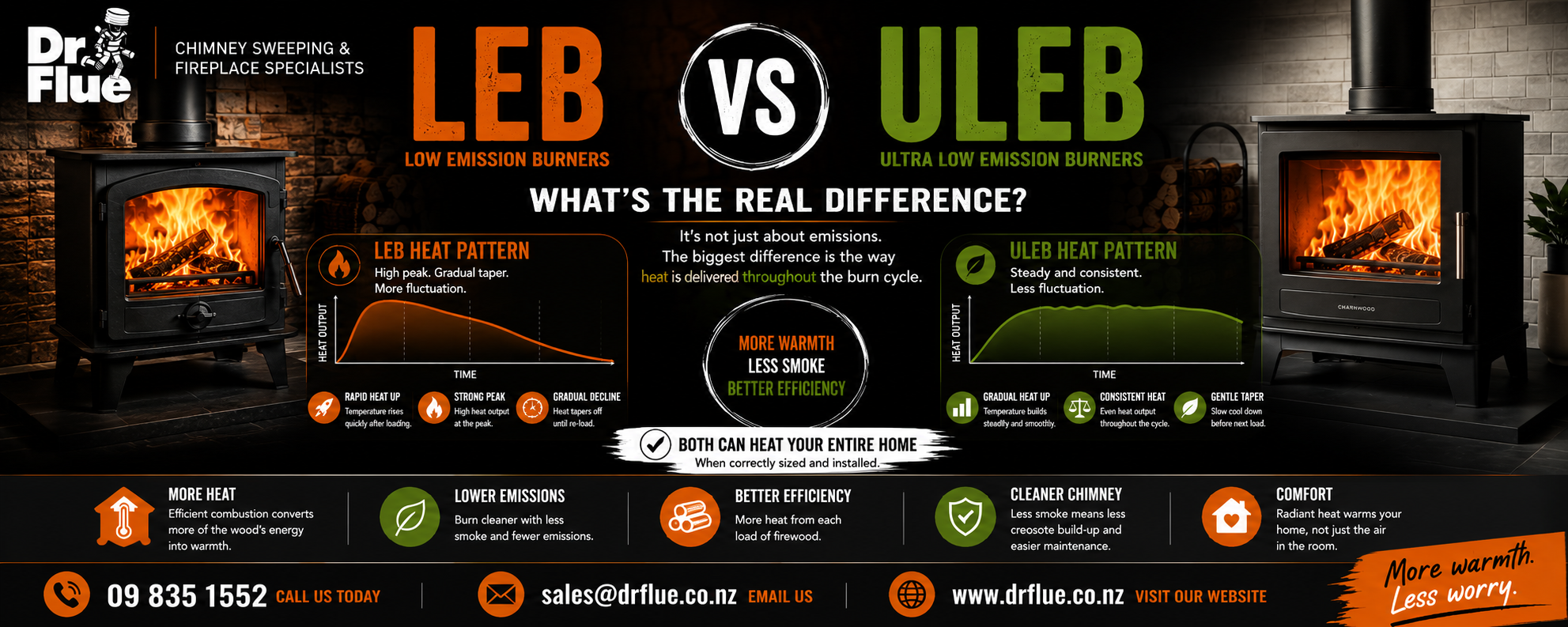
A traditional Low Emission Burner often produces a noticeable heat curve.
After loading the firebox, heat output rises quickly, reaches a strong peak, then gradually tapers away until the next load of firewood is added.
Many homeowners enjoy this style of heating because the fire can feel extremely powerful during the peak part of the burn cycle.
Low Emission Burner Heat Pattern
Typically:
Rapid temperature increase
Strong peak heat output
Gradual decline
Re-load required to return to peak output
This creates a heating pattern where the room may feel very warm shortly after loading, with heat output gradually easing back as the burn cycle progresses until the next load is added.
Ultra Low Emission Burner Heat Pattern
Ultra Low Emission Burners tend to behave differently.
Rather than producing a sharp peak followed by a long decline, many ULEBs are designed to provide a more controlled and consistent heat output throughout the burn cycle.
Typically:
Gradual heat increase
Stable operating temperature
More even heat delivery
Less fluctuation between loads
Because they don't always produce the same intense peak temperatures, some homeowners incorrectly assume they aren't producing as much heat.
In reality, they are often delivering similar total heat energy, just spread more evenly over time.
Why Some People Think ULEBs Don't Burn As Hot
It's largely a perception issue.
If you're standing beside a fireplace that produces a very high peak output, it can feel incredibly powerful.
When a ULEB delivers a steadier and more controlled heat profile, the room temperature often remains more consistent, but without the same dramatic heat spike.
Many homeowners mistake the absence of that peak temperature for lower performance.
In practice, the overall comfort level throughout the home can actually be improved because temperatures remain more stable between firewood loads.
Both Can Heat An Entire Home
Whether you're choosing an LEB or ULEB, both technologies can provide excellent whole-home heating when correctly sized and installed.
Unlike heat pumps, which primarily heat the air, wood burners generate radiant heat.
Radiant heat warms:
Floors
Furniture
Walls
Building materials
These surfaces continue releasing warmth long after the flames have reduced.
This is one reason many homeowners find a wood burner creates a different and often more comfortable type of warmth than other heating systems.
A correctly sized wood burner can often heat and dry much more than just the room in which it is installed.
Firewood Quality Still Matters
Regardless of whether you choose an LEB or ULEB, performance will always depend heavily on the quality of the firewood being burned.
Dry firewood provides:
Better combustion
Higher heat output
Reduced smoke
Cleaner flues
Lower creosote buildup
Even the most advanced wood burner will struggle to perform properly if supplied with wet or poorly seasoned firewood.
Which One Is Right For Your Home?
Both technologies represent a significant improvement over older generation fireplaces.
The best choice depends on:
Your home layout
Heating requirements
Appliance size requirements
Installation location
Available models
The most important factor is selecting the right appliance for the space you want to heat.
A properly sized and professionally installed wood burner will always outperform an incorrectly selected appliance.
The Bottom Line
Low Emission Burners and Ultra Low Emission Burners both provide efficient, reliable and effective home heating.
The biggest difference many homeowners notice isn't the amount of heat produced.
It's the way that heat is delivered.
LEBs often produce a stronger peak heat output followed by a gradual decline.
ULEBs tend to provide a steadier and more consistent heat output throughout the burn cycle.
Neither approach is necessarily better.
They're simply different ways of delivering warmth to your home.
The key is choosing the appliance that best suits your heating requirements and lifestyle.
Talk To Dr Flue
At Dr Flue, we help homeowners choose the right wood burner for their home, heating requirements and budget.
Our services include:
Replacement Wood Burners
New Wood Burner Installations
Chimney Sweeping
Fireplace Servicing
Flue System Upgrades
📞 09 835 1552
Thinking about upgrading your fireplace? Contact Dr Flue for expert advice on choosing the right wood burner for your home.