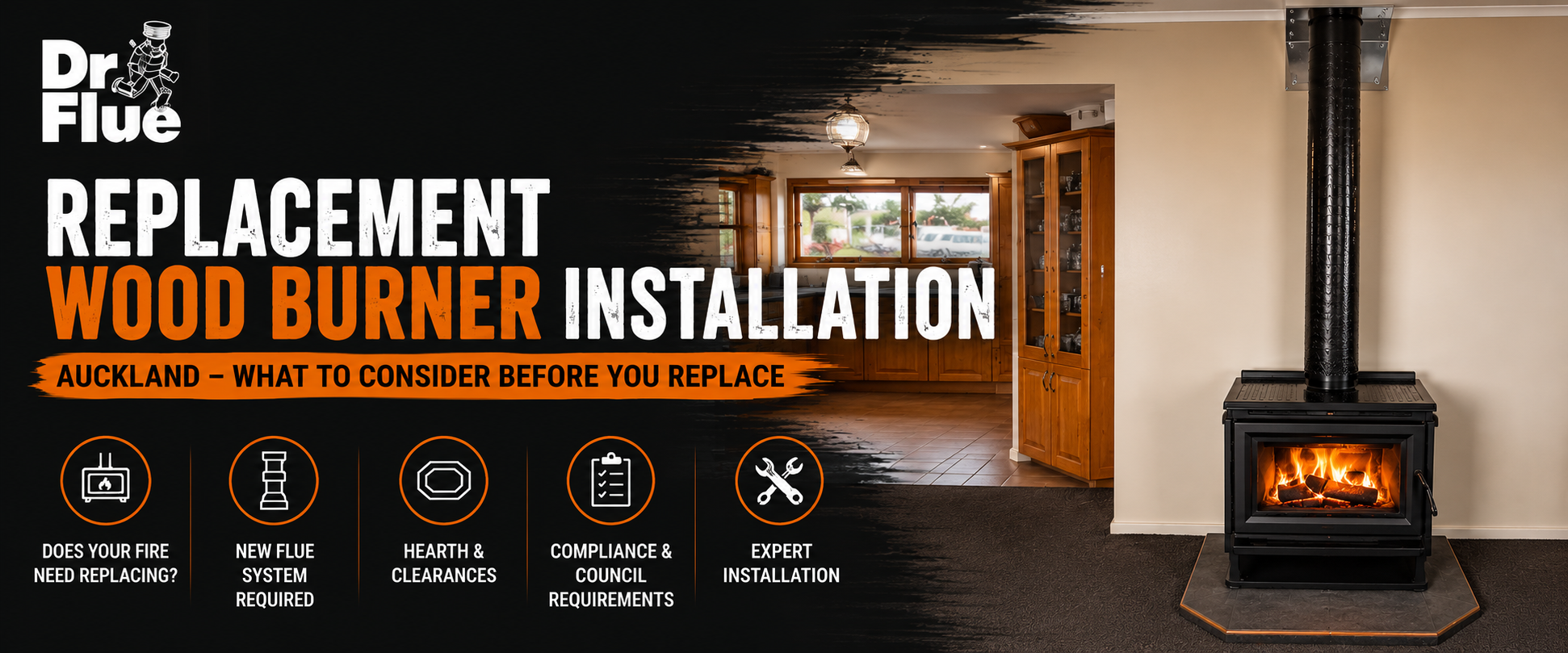
Replacing an Existing Wood Burner in Auckland
If your existing wood burner is getting older, becoming expensive to maintain or no longer heating your home effectively, replacing it can be a worthwhile upgrade.
But a replacement installation isn't simply a matter of removing the old fire and putting another one in the same position.
At Dr Flue, we assess the existing fireplace position, hearth, clearances, flue centre, roof penetration and heating requirements before recommending a replacement wood burner.
The objective is to select a fire that works properly with both the home and the new installation.
1. Does Your Existing Wood Burner Actually Need Replacing?
Age alone doesn't necessarily mean a wood burner needs to be replaced.
Many older fires can continue operating safely for years with regular servicing and replacement of consumable components such as:
Baffles
Fire bricks
Door seals
Door glass
Air controls and other service components
However, replacement may become the better option when the firebox has significantly deteriorated, major components are failing, parts are becoming unavailable or ongoing repairs are no longer economical.
Regular chimney sweeping and servicing can also help identify deterioration before a wood burner reaches the end of its service life.
2. Choosing the Right Replacement Wood Burner
The new fire needs to suit more than just the size of the room.
For a replacement installation, Dr Flue considers:
The size and layout of the home
Required heat output
Radiant or convection heating
Existing fireplace position
Hearth size and construction
Flue centre position
Required clearances
Available installation space
Wetback requirements where applicable
This is why we recommend assessing the existing installation before choosing the new wood burner.
A fire that looks like the perfect replacement on paper may not necessarily be the best choice once the existing installation is measured.
3. A New Flue Is Installed With the New Wood Burner
Dr Flue does not reuse the existing flue when installing a replacement wood burner.
The existing flue has already been exposed to years of high temperatures, combustion products, moisture and weather.
A new wood burner should be installed with a new compliant flue system, giving the new fire and flue a fresh service life together.
The new flue installation also allows us to consider:
Correct flue specification
Flue height
Flue positioning
Ceiling and roof clearances
Roof penetration
Flashing
Cowl
Draft and overall flue performance
The flue is an important part of how a wood burner performs. We therefore treat the replacement as a complete fire and flue installation, rather than simply swapping appliances.
4. Can the Existing Hearth Stay?
In many replacement installations, the existing hearth may be able to remain — but it needs to be assessed against the requirements of the new wood burner.
We look at the hearth's:
Size
Position
Construction
Condition
Required clearances
If the existing hearth isn't suitable for the selected replacement fire, we can look at alternative solutions, including a new steel hearth where appropriate.
5. Flue Centre Position Is Important
This is one of the most commonly overlooked parts of replacing an existing wood burner.
Different fires have different dimensions and flue outlet positions.
Where possible, choosing a replacement with a suitable flue centre can make for a cleaner and better-finished installation.
This is another reason why measuring the existing installation before purchasing the replacement fire is important.
6. We Look Above the Roof Too
A replacement assessment isn't limited to what's inside the house.
The existing roof penetration and surrounding area also need to be considered when planning the new flue installation.
Depending on the condition and configuration of the existing installation, the replacement may involve new flashing and external flue components as part of the completed job.
This allows the entire installation to be considered together rather than concentrating only on the new wood burner.
7. Council Consent and Compliance
Replacement wood burner installations need to meet the applicable building and compliance requirements.
Dr Flue can assist with the process from the initial assessment through to the completed installation, including the relevant council building consent and Code Compliance requirements.
Getting this right from the beginning helps avoid problems later in the installation.
8. Installation Matters as Much as the Wood Burner
The best wood burner won't necessarily deliver its best performance if the overall installation isn't right.
During a Dr Flue consultation, we're looking at more than which fire will physically fit.
We're considering the wood burner, hearth, clearances, flue configuration, roof penetration and heating requirements as one complete system.
Our goal is a replacement installation that not only looks right but performs properly and can be maintained for years to come.
Repair or Replace Your Existing Wood Burner?
Dr Flue doesn't recommend replacing an older wood burner simply because it's old.
If the fire remains safe and serviceable and replacement parts are readily available, repairing and maintaining it may still make good sense.
When significant deterioration develops, parts become difficult to obtain or repair costs start outweighing the remaining service life of the fire, it may be time to consider replacement.
Thinking About Replacing Your Wood Burner?
Talk to Dr Flue before purchasing the replacement fire.
We can assess your existing installation, discuss your heating requirements, recommend suitable replacement wood burners and provide the complete new fire and flue installation.
Book a Consultation with Dr Flue.